'/%3e%3cpolygon%20points='228.5%20230%20228.5%20811.9%200%20811.9%200%20458.4%20228.5%20230'%20fill='rgb(53,%2053,%2049)'/%3e%3cpath%20d='M814.6,227.1C813.9,101.5,711.9,0,586.2,0H0v228.5h586.2v356.3l228.5-228.5v-129.2h0Z'%20fill='rgb(53,%2053,%2049)'/%3e%3cpath%20d='M308.4,1111.8c-25.2,4.5-51.7-.6-71.5-16.8-13.6-11.2-22.6-26.9-25.7-44.3-1.7-9.5-1.7-19-.3-28.6,4.8-31.7,28.7-55.4,59.8-62.2,13.2-2.9,26.6-2.9,39.8-.2,31.2,6.5,55.4,30.2,60.5,61.8,1.5,9.6,1.5,19.1,0,28.6-5.4,32.2-30.4,55.8-62.6,61.6ZM302.2,1085.3c18-3.6,30.7-16.8,35-34.3,2.4-10.1,2.4-20.5,0-30.6-1.8-8-5.5-15.1-11-21.1-11.4-12.7-29.2-16.9-45.8-13.6-18.1,3.6-31.3,16.8-35.5,34.8-2.3,10-2.3,20.3,0,30.3,2,8.7,6.2,16.5,12.5,22.8,11.6,11.5,28.7,14.9,44.7,11.8Z'%20fill='rgb(53,%2053,%2049)'/%3e%3cpath%20d='M89,1047.2l39.9,62.9h-36.5c0,0-36.4-61.5-36.4-61.5h-23.5s0,61.5,0,61.5H1.1s0-149.2,0-149.2h74.9c5.9,0,11.4.9,16.9,2.4,18,5.3,31,19.3,32.1,38.3.4,6.6-.3,12.8-2.5,19-5.7,14.9-18.3,23.2-33.5,26.6ZM91.8,1000.8c-1.2-6.2-5.6-10.8-11.5-12.8-3.2-1-6.3-1.4-9.7-1.5h-38.1s0,38.6,0,38.6h39.7c3.6-.3,6.8-.8,9.9-2.2,8.8-3.9,11.4-12.9,9.6-22.1Z'%20fill='rgb(53,%2053,%2049)'/%3e%3cpath%20d='M771,1075.3h-65.1s-12.7,34.9-12.7,34.9h-33s59.2-149.2,59.2-149.2h39.6s59.8,149.2,59.8,149.2h-35s-12.6-34.9-12.6-34.9ZM762.5,1050.9l-24.4-63.8-23.7,63.8h48Z'%20fill='rgb(53,%2053,%2049)'/%3e%3cpolygon%20points='528.8%201032.8%20594.1%201110.2%20553.5%201110.2%20496.4%201041.2%20496.4%201110.2%20464.7%201110.2%20464.7%20961%20496.4%20961%20496.5%201028.6%20549.4%20960.9%20586.5%20961%20528.8%201032.8'%20fill='rgb(53,%2053,%2049)'/%3e%3c/svg%3e)


By ROKA Studio
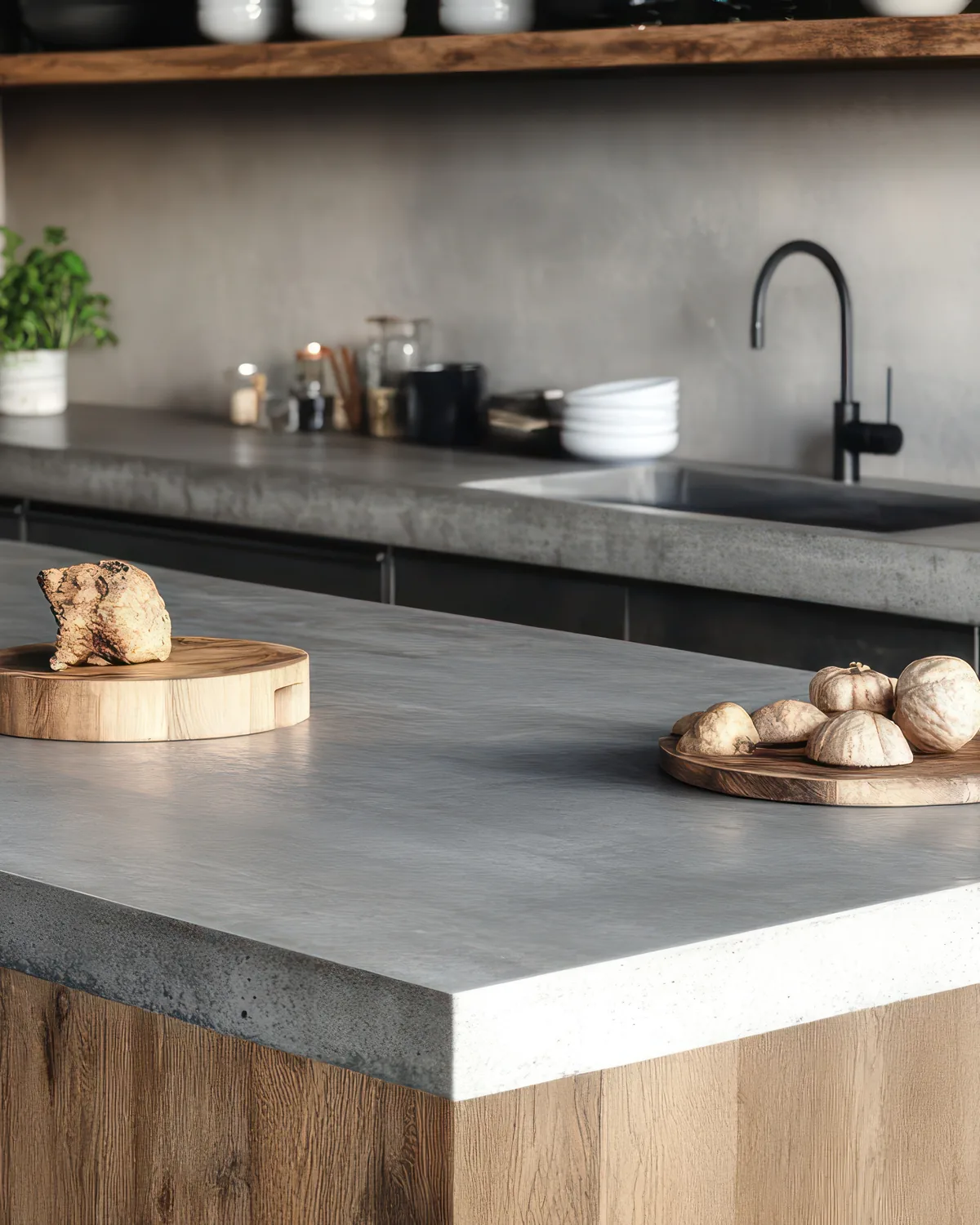
Three worktops can look near enough identical stood side by side in a showroom. Quartz, sintered stone and concrete get talked about like they're the same decision with a different price tag. They're made in three completely different ways, and that's what actually shows up in daily use.
What is a quartz worktop actually made of?
Ground quartz, about 90% of it, bound with resin and pressed under vacuum into a slab. The resin is what makes it non-porous and consistent — every slab from a run looks close to identical, which is either exactly what you want or the opposite. It doesn't need sealing. It doesn't love direct heat: a pan straight off the hob can scorch the resin, so a trivet isn't really optional.
What is sintered stone (Dekton, Neolith, and the rest)?
Mineral powders compressed and heated until they fuse, no resin holding it together. It's the process that makes rock in the ground, run in hours instead of millennia. It takes heat properly — a hot pan can go straight down — and it doesn't fade outdoors, which is why you see it as cladding as often as worktops. What it doesn't do well is take a knock on an edge. It's hard and brittle, and a corner can chip.
So what's concrete doing differently?
Ours is cast, not cut from a slab. That means a run without a join where quartz or sintered stone would need one, and a sink or drainer groove cast into the piece instead of bonded on after. It's glass-fibre reinforced — what we call GFRC — which lets us build a worktop up to its finished thickness with far less material than solid stone needs for the same look. As a reference point, a 12.5mm GFRC panel — our minimum, used for thin components like cladding tiles — works out at about 27.5kg per m², close to laminate; most worktops are cast to their full finished thickness and still come in lighter than the same thickness in solid stone. It does need sealing, unlike quartz or sintered stone. That's a different deal, not a worse one: our seal is rated to 149°C and shrugs off bleach, cola and vinegar-strength acid in testing, and hasn't needed routine resealing in our experience.
Which one takes heat best?
Sintered stone first. Quartz needs the most care. Concrete sits in between, sealed to 149°C — a pan resting for a minute, not a pan left sitting.
What happens if one gets damaged?
A chip in quartz or sintered stone usually means calling someone out, and on a sintered corner it can mean the whole slab. A mark in the seal on concrete is a patch job, repaired in place and covered by our guarantee, not a reason to replace the worktop.
Stand the three next to each other in a showroom and you'd need a spec sheet to tell them apart. Cook on them for a year and you won't need one.
See the colours and finishes for yourself.
Order free samples