'/%3e%3cpolygon%20points='228.5%20230%20228.5%20811.9%200%20811.9%200%20458.4%20228.5%20230'%20fill='rgb(53,%2053,%2049)'/%3e%3cpath%20d='M814.6,227.1C813.9,101.5,711.9,0,586.2,0H0v228.5h586.2v356.3l228.5-228.5v-129.2h0Z'%20fill='rgb(53,%2053,%2049)'/%3e%3cpath%20d='M308.4,1111.8c-25.2,4.5-51.7-.6-71.5-16.8-13.6-11.2-22.6-26.9-25.7-44.3-1.7-9.5-1.7-19-.3-28.6,4.8-31.7,28.7-55.4,59.8-62.2,13.2-2.9,26.6-2.9,39.8-.2,31.2,6.5,55.4,30.2,60.5,61.8,1.5,9.6,1.5,19.1,0,28.6-5.4,32.2-30.4,55.8-62.6,61.6ZM302.2,1085.3c18-3.6,30.7-16.8,35-34.3,2.4-10.1,2.4-20.5,0-30.6-1.8-8-5.5-15.1-11-21.1-11.4-12.7-29.2-16.9-45.8-13.6-18.1,3.6-31.3,16.8-35.5,34.8-2.3,10-2.3,20.3,0,30.3,2,8.7,6.2,16.5,12.5,22.8,11.6,11.5,28.7,14.9,44.7,11.8Z'%20fill='rgb(53,%2053,%2049)'/%3e%3cpath%20d='M89,1047.2l39.9,62.9h-36.5c0,0-36.4-61.5-36.4-61.5h-23.5s0,61.5,0,61.5H1.1s0-149.2,0-149.2h74.9c5.9,0,11.4.9,16.9,2.4,18,5.3,31,19.3,32.1,38.3.4,6.6-.3,12.8-2.5,19-5.7,14.9-18.3,23.2-33.5,26.6ZM91.8,1000.8c-1.2-6.2-5.6-10.8-11.5-12.8-3.2-1-6.3-1.4-9.7-1.5h-38.1s0,38.6,0,38.6h39.7c3.6-.3,6.8-.8,9.9-2.2,8.8-3.9,11.4-12.9,9.6-22.1Z'%20fill='rgb(53,%2053,%2049)'/%3e%3cpath%20d='M771,1075.3h-65.1s-12.7,34.9-12.7,34.9h-33s59.2-149.2,59.2-149.2h39.6s59.8,149.2,59.8,149.2h-35s-12.6-34.9-12.6-34.9ZM762.5,1050.9l-24.4-63.8-23.7,63.8h48Z'%20fill='rgb(53,%2053,%2049)'/%3e%3cpolygon%20points='528.8%201032.8%20594.1%201110.2%20553.5%201110.2%20496.4%201041.2%20496.4%201110.2%20464.7%201110.2%20464.7%20961%20496.4%20961%20496.5%201028.6%20549.4%20960.9%20586.5%20961%20528.8%201032.8'%20fill='rgb(53,%2053,%2049)'/%3e%3c/svg%3e)


By ROKA Studio
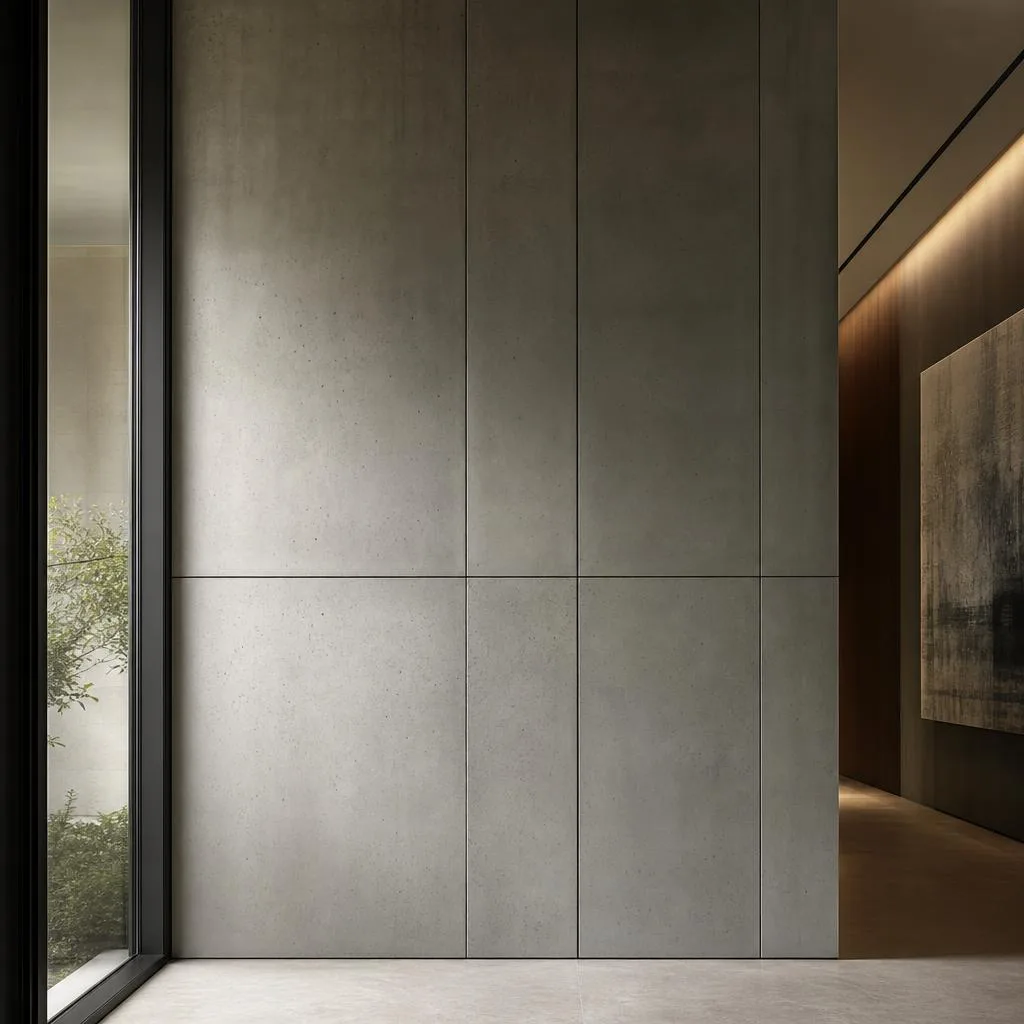
A concrete or GFRC panel that's spent its first year outside can pick up a faint chalky white bloom, especially somewhere shaded or damp. It isn't damage, and on a dense, low-porosity mix like the one in our cladding tiles it doesn't spread or get worse. It's efflorescence, and it's almost always cosmetic.
What actually causes the bloom?
While a panel cures, moisture inside the mix carries dissolved calcium hydroxide up to the surface. As that moisture evaporates, the calcium hydroxide reacts with carbon dioxide in the air and leaves a thin, chalky film of calcium carbonate sitting on top of the surface, not mixed into it. It's the same white bloom you'll have seen on plain grey concrete; it just shows more on a coloured mix, where reds go pinker, browns tan out and blacks turn a duller grey.
Is that the same thing as the colour looking lighter when it's new?
No, and it's worth telling apart. A fresh cast reads darker and duller for its first week simply because it's still wet — water in the surface pores lets light through instead of scattering it, the effect covered in why fresh concrete looks wrong until it's dry. Efflorescence is different: it's a real deposit sitting on the surface, it can turn up weeks or months after casting, and it has nothing to do with the drying schedule.
Does it get worse outside, over years?
Mostly not. It's usually heaviest early on, while there's still free lime near the surface to carry, and normal weathering and rain wash it away over time. In an exposed or coastal spot it can reappear as a light, wash-off salt bloom rather than a permanent stain. What it doesn't do, on a dense, low-porosity mix, is undermine the panel: the freeze-thaw resistance of a well-cured GRC mix like ours comes from that same low porosity plus the glass fibre, and the material has decades of field use in northern Europe with no reported scaling from it.
What about the colour fading in sunlight?
That one's simpler: it doesn't. We colour with inorganic oxide pigments, and neither those pigments nor the cement paste itself degrade under UV. What changes a panel's look outdoors over the years is ordinary weathering — a light carbonated skin, dirt pickup, rain patterns — and that's cosmetic too.
Full detail on cladding tiles, fixing and lead times is on our concrete cladding page.
See the colours and finishes for yourself.
Order free samples